Simplify Your Payouts with Profit Sharing Software
By Gilad Uziely ·
Employers are always looking for better ways to incentivize their teams. While 401(k) plans have become standard, many business owners are finding that a well-structured profit sharing program can be a valuable tool for tying employee performance directly to business growth.
According to guidance from payroll leaders like ADP, these plans can be highly effective in attracting and retaining key talent by giving them a real stake in the company's success. Sharing the profits sounds great in theory, but the execution can quickly become an operational headache.
For a small team, you might be able to handle it with a spreadsheet. But as your company grows, calculating each employee's share, ensuring accuracy, and processing the payments turns into a significant administrative burden. This manual work pulls your focus away from the activities that actually generate the profit you're trying to share.
The process is fragile, doesn't scale, and is filled with opportunities for costly errors. This is where automation and dedicated profit sharing software become necessary for any business serious about growth.
The Resurgence of Profit Sharing
S. employers. It's a fantastic tool, but it doesn't always create a direct line of sight between an employee's daily work and the company's financial performance.
In response, many innovative companies are bringing back the profit sharing plan to stand out in a competitive job market by fostering a culture of ownership.
When employees know that their hard work contributes to a bigger profit pool that they get a piece of, their perspective shifts. They start thinking more like owners, looking for efficiencies and opportunities to help the business thrive. This is especially true in high-growth sectors.
4 trillion by 2030, and the competition for skilled engineers, salespeople, and managers is intense. A robust profit sharing program for employees can be a deciding factor for a top candidate.
Key benefits of implementing a profit sharing program include:
- Increased Motivation: Directly connects individual effort to company-wide success, boosting morale and productivity.
- Talent Attraction: A meaningful profit share can be a more compelling offer than a slightly higher salary, especially if it demonstrates a stronger company culture.
- Improved Retention: Employees with a stake in the company's long-term success are more likely to stay, reducing turnover costs.
- Business Flexibility: Unlike fixed salary increases, profit sharing contributions can be adjusted or paused in leaner years, giving the business financial flexibility.
Why is Managing a Profit Sharing Program Manually So Hard?
 If you've ever tried to manage profit distributions yourself, you already know the challenges. What starts as a simple idea—"let's give everyone 10% of the profits"—quickly unravels into a complex administrative task. The process is often opaque and feels less like a reward and more like a source of confusion.
The first hurdle is the calculation. Most plans aren't a simple, even split. They often use a formula that considers factors like salary, tenure, or position.
A senior employee who has been with the company for a decade will likely receive a different share than a new hire. Tracking this in a spreadsheet for a handful of employees is doable, but for a team of 15, 30, or 100, it becomes a nightmare of formulas and VLOOKUPs. One incorrect data entry can throw off the entire distribution.
Then comes the payout. You have to get the money from the company's bank account to each employee. This could mean manual wire transfers or complicated adjustments in your payroll system, both of which take time and open the door for more errors.
The entire process is a significant time drain for business owners and their finance teams, pulling them away from strategic work. This administrative drag is precisely why so many small businesses that start with a profit sharing program abandon it as they grow, the manual system simply can't keep up. The right profit sharing software is designed to solve this exact scaling problem.
How Does Profit Sharing Software Solve These Problems?
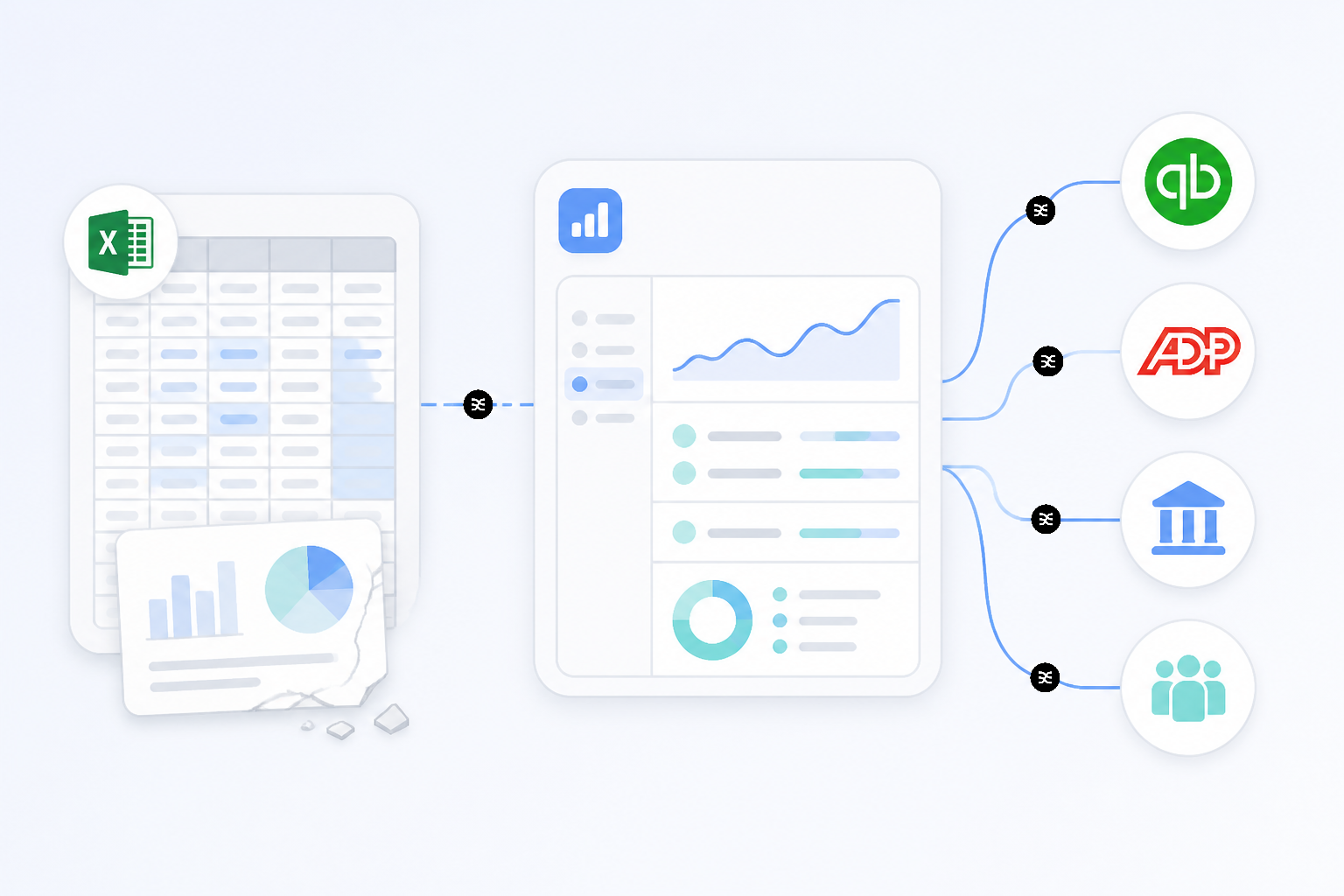 Automating your profit sharing program for employees frees you from the spreadsheet trap. Instead of acting as the manual operator of a rickety financial process, you become an architect of a smooth, reliable system. The software handles the tedious details, allowing you to focus on the bigger picture.
Automating Complex Calculations
The core function of profit sharing software is to eliminate manual math. Set the rules of your profit sharing plan once within the system. These rules can be simple or multi-layered, incorporating variables like:
- The total profit pool for the period.
- Each employee's salary and tenure.
- Performance tiers or departmental weights.
Once the rules are set, the software does the rest. You input the total profit figure for the quarter or year, and the platform instantly calculates the precise share for every eligible employee. This aligns with a broader trend in business operations to move from manual tasks to scalable solutions, reducing human error and freeing up valuable time.
Streamlining Payouts and Reporting
After calculations are done, the software helps execute the payments. Many platforms integrate directly with popular payroll systems. With a few clicks, the profit sharing distributions can be added to the next payroll run, ensuring everyone gets paid correctly and on time.
This removes the risk and hassle of manual bank transfers.
Transparency is just as important. Good profit sharing software provides clear dashboards and reports for businesses and their teams. The total distribution can be seen at a glance, and each employee can log into a personal portal to see their share and understand how it was calculated.
This openness builds trust and reinforces the value of the program.
| Feature | Manual Spreadsheet | Profit Sharing Software |
|---|---|---|
| Calculation | Manual data entry, prone to formula errors | Automated and verified based on set rules |
| Payouts | Separate, manual bank transfers or payroll entry | Integrated with payroll for automated distribution |
| Transparency | Opaque; requires one-on-one explanations | Clear employee dashboards and reports |
| Scalability | Becomes unmanageable with team growth | Scales effortlessly from a few employees to hundreds |
| Compliance | Difficult to track and produce records for audits | Creates a clear, auditable trail of all calculations and payouts |
What to Look For in Profit Sharing Software
Choosing the right profit sharing software depends on the complexity of your plan and the systems you already use. As options are evaluated, look for a solution that provides flexibility and can grow with your business.
The best systems are often cloud-based, reflecting the broader industry shift toward accessible and scalable tools. In fact, some analyses project that the market for cloud-based enterprise systems will grow at 13.5% annually, outpacing even the rapid growth of the overall software market.
Here are a few essential features to consider:
- Flexible Plan Configuration: Businesses are unique, and their profit sharing plans should be too. The software should allow for custom rules to be defined for eligibility, vesting schedules, and calculation formulas.
- Integration Capabilities: To achieve true automation, the software must connect with your existing financial stack, particularly your accounting and payroll systems. This ensures a seamless flow of data and funds.
- Employee-Facing Portal: A clean, intuitive dashboard for employees is critical. It provides the transparency needed to make the program a true motivator, not a source of confusion.
- Robust Reporting: Clear reports for financial analysis and compliance are needed. The software should provide a detailed audit trail of all calculations and distributions.
For businesses with highly custom needs, such as splitting revenue from specific projects or managing multi-layered commission structures in addition to profit sharing, a more fundamental money-routing tool might be required. For instance, a platform like Sequence allows business owners to visualize all their accounts and create automated rules to move money between them. " This provides a flexible foundation for funding and executing all kinds of complex payouts, which is particularly useful for businesses that need more than just standard split billing software.
From Manual Work to Strategic Automation
Implementing a profit sharing program is a strategic decision to invest in a team and align everyone around the goal of growth. But the operational side of that decision can quickly undermine its value if it introduces hours of manual work and risk. A manual process does not just consume time, it creates a ceiling on the ability to scale the very culture being built.
Adopting automated profit sharing software lifts that ceiling. It transforms the distribution process from a quarterly chore into a smooth, reliable, and transparent system.
This is consistent with a larger shift across all industries: successful businesses are automating operational finance to free up leaders for more strategic work. 8% of revenue, every operational efficiency counts.
By automating profit distribution, businesses are not just buying a piece of software, they are investing in accuracy, transparency, and scalability. Most importantly, it ensures that the profit sharing plan remains a valuable incentive that strengthens company culture, rather than a logistical burden that holds it back.